June 18, 2026 — Lehi, UT
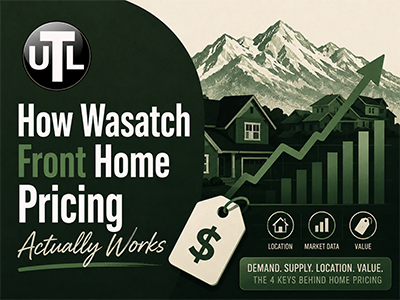
Of all the decisions a seller makes, none shapes the outcome more than the asking price. Set it right and a home tends to draw its strongest interest early, when buyer attention is highest. Set it wrong and even a beautiful property can sit. Here is how home pricing actually works along the Wasatch Front — and why the number you land on matters more than almost anything else in the sale.
The List Price Is Not a Guess
A good asking price is built from evidence, not optimism. It starts with what comparable homes near you have actually sold for — not what they were listed at, and not what a neighbor hopes their place is worth. From there, a pricing strategy accounts for the realities of your specific home and the moment you are selling into.
What Actually Determines Your Home’s Value
Several factors work together to set a defensible price:
- Recent comparable sales — closed prices on similar homes nearby, ideally within the last few months.
- Condition and updates — finishes, mechanicals, roof and windows, and whether the home shows move-in ready or needs work.
- Location within the micro-market — school boundaries, commute to the Silicon Slopes corridor, lot, view, and street.
- Current competition — how many similar homes are on the market right now, and how yours stacks up against them.
- Timing and seasonality — buyer demand, interest-rate conditions, and where we are in the local selling cycle.
This is why two homes on the same street can carry very different values. Square footage is only the starting point.
How a Comparative Market Analysis Works
A comparative market analysis (CMA) is the tool that turns all of those factors into a price range. It pulls recent sold comparables, adjusts for the differences between those homes and yours, layers in active competition, and produces a realistic range rather than a single magic number. A good CMA also tells you something just as useful: where the price stops being supportable, so you do not list into thin air.
Curious where your home lands? You can request your free market analysis and get a clear, data-backed range before you make any decisions.
The Real Cost of Overpricing
Overpricing feels safe — you can always come down, right? In practice it tends to cost sellers money. The freshest, most motivated buyers see your home in the first couple of weeks. Price above the market and those buyers skip it, showings thin out, and the listing starts to look stale. The eventual price cuts often land below what a well-priced listing would have earned from day one, because momentum is hard to rebuild once it is lost.
Pricing Shifts by Wasatch Front Submarket
The same pricing principles apply everywhere, but the numbers behind them vary by area:
- Lehi, Saratoga Springs, and American Fork — tech-corridor demand and newer construction shape comps here.
- Draper, Sandy, and Cottonwood Heights — established neighborhoods where condition and lot often drive value.
- Salt Lake City and Holladay — character homes and location premiums that vary block to block.
- Park City and Heber City — a distinct market where seasonality and second-home demand carry real weight.
A price that makes sense in one of these areas can be off the mark in another, which is why local comps matter so much more than statewide averages.
When to Revisit Your Price
Even a well-set price deserves a check-in. If your home draws plenty of online views but few showings, the price is usually the message. If it draws showings but no offers, the issue is more often condition or presentation. Reading those signals early — and adjusting deliberately rather than reactively — keeps a listing on track.
Pricing a home well is part data, part strategy, and part knowing the Wasatch Front block by block. If you are weighing a sale this year, the simplest first step is a conversation about what your home could realistically command today. Learn more about selling with UTLocal, or start a conversation through the contact form and Olivia Pelton, Associate Broker with Presidio Real Estate, will put together a tailored market analysis for your home.
UTLocal serves sellers in Lehi, Saratoga Springs, Draper, Sandy, Salt Lake City, Holladay, Cottonwood Heights, Provo, Orem, American Fork, Park City, Heber City — and surrounding Wasatch Front communities.