April 29, 2026 — Heber City, UT
The Wasatch Back has a rhythm that out-of-state buyers tend to miss on their first pass. Park City Mountain Resort and Deer Valley close in early April. The trails are too soft to hike, the reservoirs are too cold to launch on, and the whole valley settles into a quiet stretch of about six weeks before summer tourism wakes it back up after Memorial Day.
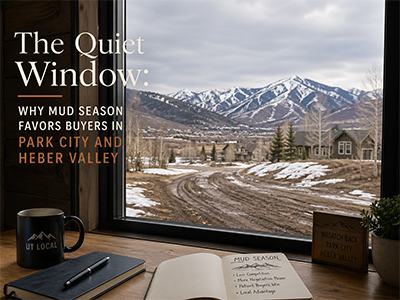
Locals call it mud season. And from a buying standpoint, it’s one of the most underrated windows of the year on the Wasatch Back — especially in 2026, with inventory and patience both running higher than they have in recent memory.
What Mud Season Actually Is
Mud season is the unofficial in-between period that runs from the closing of the ski resorts through roughly Memorial Day weekend. The snow on the high peaks holds, but the valley floor thaws, refreezes, and finally gives way to mud. Daily rental traffic in Park City drops off sharply. Restaurants reduce hours. Some shops on Main Street close for a week or two of cleaning and inventory.
For visitors, it’s a strange in-between time. For people who actually live and work in Park City and Heber Valley, it’s the cleanest stretch of the year — no ski crowds, no summer traffic, no Sundance, no Tour of Utah. The valley pauses and exhales.
And the real estate market pauses with it.
Why the Quiet Window Favors Buyers in 2026
The Wasatch Back has shifted meaningfully from the pandemic-era frenzy. A few of the conditions worth knowing right now:
- Inventory is up. Single-family supply on the Park City and Snyderville Basin side is sitting at roughly six months — closer to a balanced market than the seller’s market we saw two and three years ago.
- Days on market have lengthened. Homes that would have moved in two weeks in 2022 are now sitting for two to three months. That stretches negotiating leverage back toward buyers.
- Mid-tier homes are softer than luxury. The segment under about $2.5M is moving at a more deliberate pace than ski-adjacent luxury, which continues to draw cash buyers in places like The Colony and Promontory.
- Sellers who listed for spring are reassessing. A property that hit the market in February or March without an offer by late April is a property whose owner is rethinking price and timing.
- Mortgage rates have stabilized in the high 6s. Not a tailwind, but a known factor — and one that’s already been priced into seller expectations.
None of this is a crash. It’s a recalibration. But during mud season specifically, the gap between motivated sellers and patient buyers is at its widest.
How the Submarkets Look Right Now
Park City proper. The 84060 ZIP carries the city’s most exclusive inventory — Old Town, Deer Valley, Park Meadows. Single-family selection is still tight; condos offer broader choice and the cleanest mud-season negotiating room.
Snyderville Basin. The 84098 side — Kimball Junction, Pinebrook, Silver Springs, Jeremy Ranch — is where most year-round Park City residents actually live. More inventory turnover, more variety in price band, and a friendlier entry point well under $2M.
Heber City. The most affordable foothold on the Wasatch Back. Range stretches from the mid-$400Ks for older homes near downtown up through Red Ledges luxury well above $3M. Heber has been the fastest-growing piece of the valley for several years running, with new construction filling in the east bench.
Midway. Smaller, premium, and famously protective of its character. Inventory is thin year-round, but mud season is one of the few moments when something interesting can sit long enough to negotiate without elbowing through other buyers.
Charleston, Daniel, and the south end of the valley. Larger lots, more agricultural feel, and slower turnover. Worth a look for buyers prioritizing acreage and quiet over walkable downtown.
Send a quick message through our contact form and we’ll set up a buyer consultation for the Wasatch Back — no pressure, just a real conversation about what actually fits the way you want to live.
What to Actually Look At During a Mud-Season Showing
The flip side of buying in mud season is that the property looks worse than it will in three weeks. Don’t let that scare you off — it’s actually a feature, not a bug. You’re seeing the property at its least flattering, and that’s a useful angle.
- Drainage and grading. Mud season shows you exactly where the water goes when the snow leaves. Walk the lot. Look at the foundation perimeter. Note any standing water, settling, or eroded grade.
- Access roads. If a property is on a private or shared dirt road — common in Charleston, Woodland, Kamas, and parts of Midway — mud season tells you whether the road is actually passable in shoulder season, not just in summer.
- Snow load patterns. The last patches of snow on a roof or yard reveal where shadows fall, where ice dams form, and where solar gain is weakest.
- Wildfire setback and defensible space. The brown grass of late April makes wildfire risk visible in a way that summer green hides. Pay attention to vegetation, slope, and proximity to wildland.
- HOA documents and short-term rental rules. The Wasatch Back has some of the most varied STR zoning in Utah. Two homes a hundred yards apart can have completely different nightly rental rights. Read the HOA docs and the city or county overlays carefully before you make an offer.
The Tradeoffs Worth Knowing
Mud season isn’t a cheat code. There are real tradeoffs:
- Selection narrows before it widens. Inventory in the Wasatch Back peaks in late May and June. If you’re open to waiting four to six weeks, you’ll see more homes — but you’ll also see more competing buyers.
- Some sellers withdraw and relist. Owners who didn’t get the spring offer they wanted sometimes pull their listing and try again in June with a fresh days-on-market clock. That’s a signal worth tracking.
- Inspections find more. The same conditions that reveal drainage issues to you also reveal them to the inspector. That’s a benefit, but it usually means more items to negotiate — or to walk away from cleanly.
Moving Now Versus Waiting
If your timeline is flexible and you’re primarily after maximum selection, summer will give you more options. If your timeline favors lower competition, real negotiating room, and the ability to see a property at its most honest, the next four to five weeks are the cleanest window of the year on the Wasatch Back.
Either way, the conversation is worth starting now. Inventory takes time to walk, and the Wasatch Back rewards buyers who’ve done their homework before the listing they actually want appears.
If you’re thinking about a move to Park City, Heber City, Midway, or anywhere across the Wasatch Back — or just want a real read on the market before you commit to a timeline — request a free Wasatch Back consultation. We’ll talk through what you’re looking for and put a plan together that fits the way you actually want to move.
UT Local serves buyers and sellers across Lehi, Saratoga Springs, Draper, Sandy, Salt Lake City, Holladay, Cottonwood Heights, Provo, Orem, American Fork, Park City, Heber City — and surrounding Wasatch Front communities.


Leave a Reply